
Critical Regionalism in Architecture: The Importance of Context, Climate, and Culture
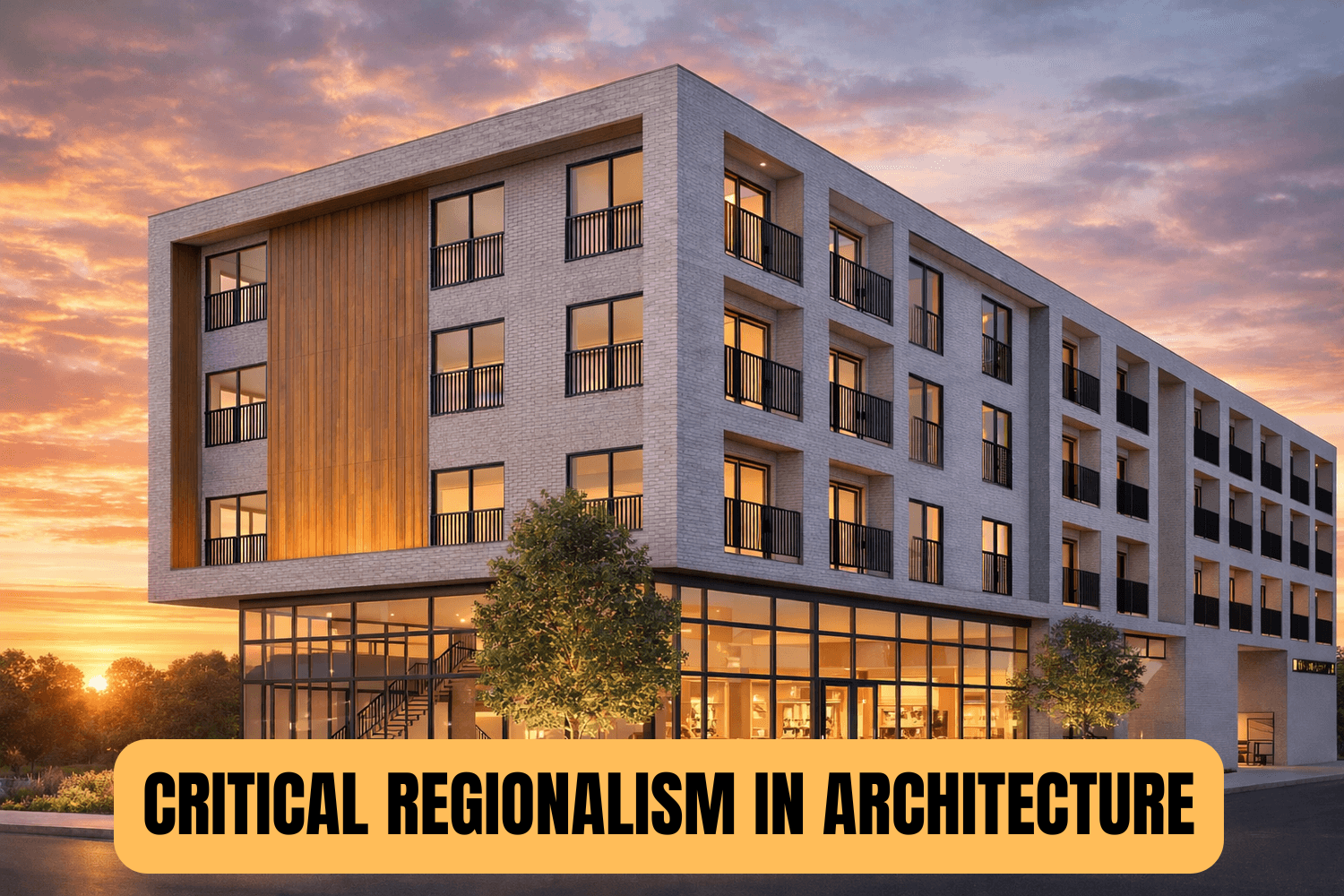
In an age where cities across the world often look increasingly similar, the concept of Critical Regionalism offers a powerful alternative. It proposes an architecture that is modern and progressive, yet deeply rooted in the specific qualities of a place, such as its climate, culture, landscape, and materials.
First articulated in the early 1980s by architectural historian Kenneth Frampton in his influential essay “Towards a Critical Regionalism: Six Points for an Architecture of Resistance”, the concept remains one of the most important theoretical frameworks in contemporary architecture. It is not a style. It is not a return to the past. It is an approach to design that resists placeless global uniformity while embracing the realities of modern civilization.
This blog explores the origins, principles, characteristics, and continuing relevance of Critical Regionalism in detail. Let’s dive in.
The Historical Context
Critical Regionalism emerged during a period of architectural transition. After the dominance of Modernism, with its universal language of glass, steel, and concrete, architecture began to face criticism for becoming detached from local culture and climate. Modern buildings often appeared identical whether they were in Tokyo, London, or São Paulo.
At the same time, Postmodernism attempted to reintroduce historical references, but often through surface-level ornamentation and stylistic imitation.
Frampton proposed a third path.
Instead of copying historical forms or embracing universal abstraction, Critical Regionalism aimed to mediate between global modern techniques and the specific conditions of a place. It was a call for architectural resistance against homogenization.
The term itself was first introduced by theorists Alexander Tzonis and Liane Lefaivre, and later developed in depth by Frampton.
What Critical Regionalism Is And What It Is Not
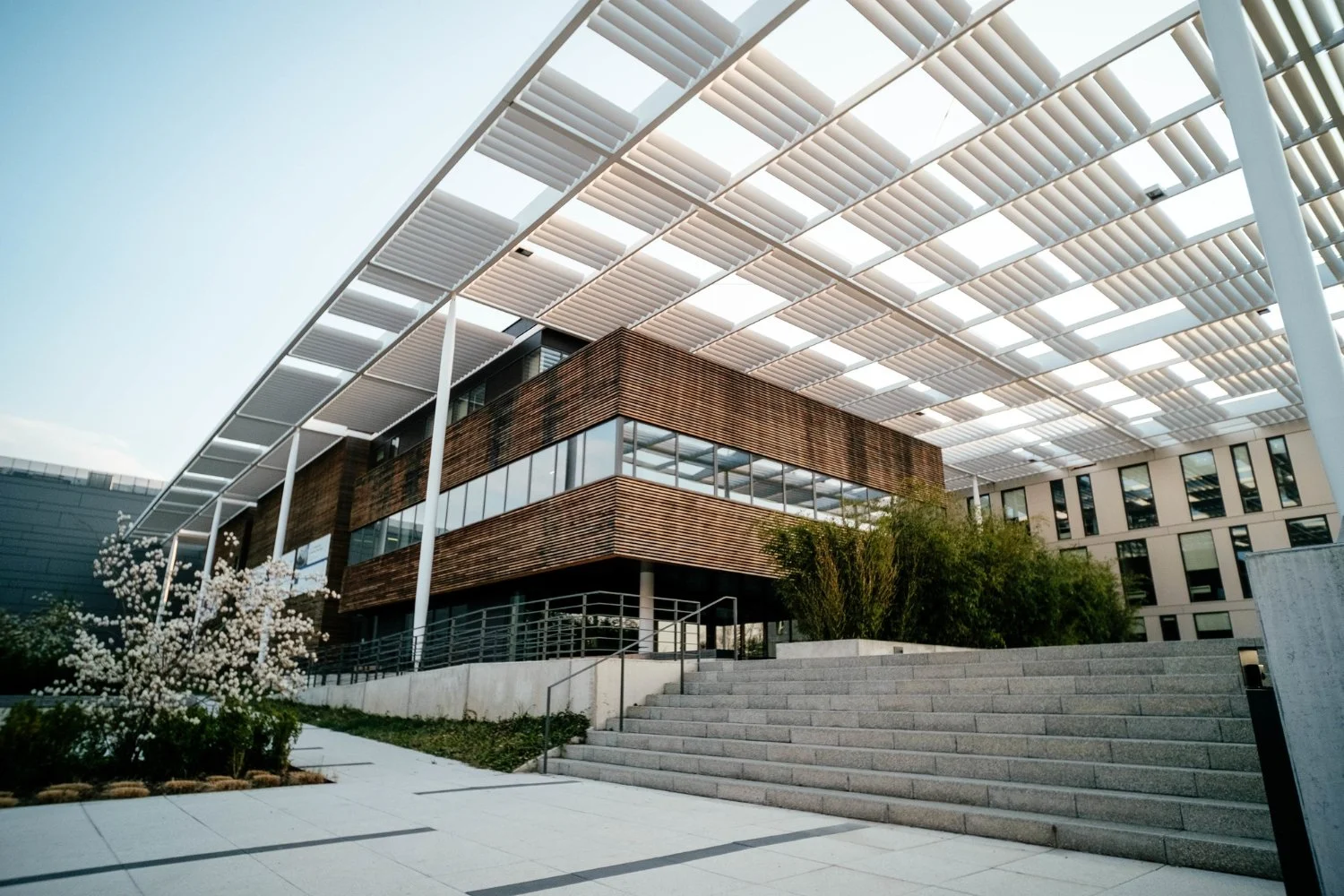
To understand Critical Regionalism clearly, it is important to distinguish it from related ideas:
It Is Not:
Simple regionalism (which merely replicates local styles)
Vernacular revivalism
Romantic nostalgia
Decorative historicism
It Is:
A critical reinterpretation of local traditions
A modern architecture grounded in climate and topography
A tectonic expression of materials and structure
A design approach that enhances the experience of place
Critical Regionalism accepts the inevitability of modern technology and global culture. However, it filters these influences through local conditions.
The Six Core Principles of Critical Regionalism

In his essay, Frampton outlined six fundamental points that define this approach. These principles form the theoretical backbone of Critical Regionalism.
1. Culture and Civilization
Architecture must negotiate between universal civilization (technology, modern construction methods, industrialization) and local culture (traditions, climate, craftsmanship).
It does not reject modernization. Instead, it seeks to prevent cultural identity from being erased by it.
2. The Resistance of Place-Form
Modern architecture often treats sites as neutral grounds on which buildings are placed. Critical Regionalism opposes this idea.
Buildings should emerge from the site. Topography, landscape, and urban fabric must influence form. The building should not dominate the land but work with it.
This creates a reciprocal relationship between architecture and its environment.
3. Culture vs. Nature
Critical Regionalism emphasizes a dialectical relationship between built form and natural conditions.
Climate, sunlight, wind patterns, and seasonal changes are not secondary considerations. They are primary design generators.
Architecture should respond to:
Local light quality
Temperature variations
Prevailing winds
Natural ventilation opportunities
In this way, sustainability is not an afterthought, it is embedded in design.
4. Tactility and the Experience of Architecture
One of the most important aspects of Critical Regionalism is its focus on sensory experience.
Modern architecture often prioritizes visual form. Critical Regionalism emphasizes:
Texture
Material weight
Craftsmanship
Acoustic qualities
Thermal sensations
Architecture should be experienced through the body, not just seen from a distance.
5. The Role of Tectonics
Tectonics refers to the expressive potential of structure and construction.
Instead of hiding structure behind decorative facades, Critical Regionalism encourages clarity in how buildings are made. Materials should express their inherent properties.
Concrete should look and feel like concrete.
Wood should express its grain and warmth.
Stone should convey its mass and permanence.
In this way, construction becomes a cultural expression.
6. The Importance of Boundaries
Critical Regionalism gives importance to thresholds, transitions, and spatial hierarchies.
Public and private spaces should be clearly articulated. Courtyards, verandas, shaded passages, and transitional spaces play a vital role in mediating between inside and outside.
This reinforces the connection between architecture and everyday life.
Key Architects Associated with Critical Regionalism
While Critical Regionalism is not a formal movement, several architects exemplify its principles.
Alvar Aalto
His work integrates modernist clarity with sensitivity to light, material, and landscape.

Photo courtesy: Comet Photo AG
Jørn Utzon
Utzon’s designs demonstrate deep engagement with climate and cultural context.

Photo courtesy: Ulf Nilsen
Álvaro Siza
Siza’s projects are rooted in site conditions while remaining unmistakably contemporary.

Photo courtesy: March Valencia
Luis Barragán
His use of color, light, and spatial intimacy embodies the sensory dimension of Critical Regionalism.

Photo courtesy: Arquitectura Viva
Why Critical Regionalism Still Matters Today
In today’s globalized world, architecture is often driven by branding, speed, and replication. Glass towers and standardized commercial buildings dominate urban landscapes.
Critical Regionalism provides a framework for resisting this uniformity.
Its relevance today can be seen in:
Bioclimatic design strategies
Use of local materials
Low-carbon construction methods
Community-centered urban design
Sustainability and Critical Regionalism are deeply connected. When architecture responds to climate and site, energy efficiency naturally improves.
Moreover, in a time when cultural identity is increasingly valued, place-based architecture fosters belonging.
Strengths and Criticisms
Strengths:
Encourages contextual sensitivity
Promotes sustainable practices
Respects cultural identity
Enhances sensory architectural experience
Criticisms:
Some critics argue that Critical Regionalism:
Is difficult to define precisely
Risks becoming another aesthetic category
Can be selectively interpreted
However, its strength lies in being a methodology rather than a style. It provides principles, not templates.
Critical Regionalism and Contemporary Practice

Today, many architectural firms operate within the spirit of Critical Regionalism, even if they do not use the term directly.
Projects that integrate passive cooling systems, utilize local craftsmanship, adapt to topography instead of flattening it, and respect historical urban patterns are practicing its principles.
The concept has moved from theory into mainstream architectural thinking.
Conclusion
Critical Regionalism reminds us that architecture is not just building materials, it has a cultural root too..
A building must do more than function. It must belong.
By balancing global knowledge with local intelligence, by embracing both technology and tradition, Critical Regionalism offers a disciplined, thoughtful path forward.
It challenges architects to design with awareness:
Awareness of climate
Awareness of culture
Awareness of material
Awareness of place
In a world increasingly shaped by sameness, Critical Regionalism insists on meaningful, place-driven identity.
It is not about looking regional.It is about being regional - critically, consciously, and responsibly.