What Are Mixed-Use Developments? Benefits, Types, and Why They're Shaping the Future of Cities
Key Takeaways
Mixed-use developments provide a sustainable and efficient urban model by integrating residential, commercial, and civic spaces into walkable communities. Their core value lies in reducing car dependency, fostering social connection, and creating resilient local economies that prioritize human needs over automobile infrastructure.
Table of Contents
Why Mixed-Use Development Continues to Thrive
Imagine living in a neighborhood where your morning starts with a short walk to a local coffee shop, your office is only a few blocks away, your children can safely bike to school, and groceries, parks, restaurants, and entertainment are all within easy reach. Instead of spending hours in traffic, you spend more time with family, supporting local businesses, or enjoying public spaces.
For many of the world's most successful cities and neighborhoods, this isn't a new idea; it's a proven way of building communities. Mixed-use development has long brought homes, workplaces, shops, restaurants, and public spaces together to create vibrant places where people can live, work, and connect.
Throughout much of the 20th century, however, many communities embraced zoning policies that separated residential, commercial, and industrial uses into distinct districts. While this approach addressed important public health and industrial concerns at the time, it also contributed to challenges such as urban sprawl, car dependency, longer commutes, rising infrastructure costs, and neighborhoods with fewer opportunities for everyday interaction.
Today, mixed-use development continues to demonstrate why it's one of the most effective models for creating resilient, walkable, and economically vibrant communities. Rather than representing a new direction for urban planning, it remains a proven strategy that developers, municipalities, and architects continue to refine to meet the changing needs of modern cities.
Mixed-Use Development in Practice
At Sidney Aulds Building Studio, mixed-use development isn't just a planning concept—it's a core part of our architectural practice. We've designed projects ranging from urban infill developments to large-scale master-planned communities, helping clients create places where people can live, work, shop, and connect. Throughout this guide, we'll reference both industry-leading examples and lessons drawn from our own mixed-use projects.
As governments, developers, architects, and urban planners continue seeking ways to accommodate population growth while improving quality of life, mixed-use developments remain one of the most effective and resilient models for urban development. By thoughtfully integrating residential, commercial, recreational, and civic spaces into connected, walkable communities, these developments have consistently demonstrated their ability to support economic growth, encourage sustainable land use, and create places where people genuinely want to live, work, and gather.
But mixed-use development is much more than placing apartments above retail stores or offices next to restaurants. When planned intentionally, it creates complete communities where housing, employment, shopping, recreation, and public spaces work together to support everyday life. This integrated approach has helped revitalize downtown districts, strengthen suburban town centers, and guide the development of new master-planned communities across the United States.
In this guide, we'll explore what mixed-use developments are, the different types of mixed-use projects, the principles that make them successful, their benefits and challenges, and why they continue to be one of the most valuable development strategies for creating sustainable, vibrant communities.
What Is Mixed-Use Development?
A mixed-use development is a property, building, or master-planned community that intentionally combines multiple land uses within a single, integrated environment.
Rather than separating residential neighborhoods from offices, retail centers, entertainment venues, and public spaces, mixed-use developments bring these functions together to create complete communities that are convenient, walkable, and connected.
Depending on the scale of the project, a mixed-use development may include:
Residential apartments, condominiums, or townhomes
Office buildings and coworking spaces
Retail stores and neighborhood shopping
Restaurants, cafés, and entertainment venues
Hotels and hospitality spaces
Parks and public plazas
Community centers
Healthcare facilities
Educational spaces
Fitness and recreational amenities
The defining characteristic isn't simply the variety of buildings, it's how these different uses interact.
A successful mixed-use development is carefully planned so that residents can accomplish many of their daily activities without relying heavily on a car. Shops support nearby residents, offices generate customers for local restaurants, parks encourage community interaction, and public spaces become gathering places that remain active throughout the day.
This intentional integration creates neighborhoods that are more vibrant, resilient, and people-focused than traditional single-use developments.
Mixed-Use Development vs. Multi-Use Development
One misconception is that any project containing multiple building types qualifies as mixed-use.
It doesn't.
There's an important distinction between multi-use and mixed-use development.
A multi-use project may simply place apartments, offices, and retail buildings within the same area while allowing each function to operate independently. Residents may still need to drive between destinations, and public spaces may lack activity or connection.
A true mixed-use development, on the other hand, is intentionally designed around integration. Land uses complement one another, pedestrian movement is prioritized, and public spaces encourage interaction throughout the day.
For example, a residential tower with ground-floor retail, upper-level offices, outdoor dining, landscaped public plazas, and direct access to public transit creates an interconnected environment where each component supports the others.
This difference may seem subtle, but it often determines whether a development becomes a thriving community or simply a collection of unrelated buildings.
The Evolution of Mixed-Use Development
Although mixed-use development is often presented as an innovative planning strategy, the concept itself is centuries old.
Before Modern Zoning
Historically, cities naturally developed as mixed-use environments.
People lived close to where they worked. Markets operated alongside homes. Shops occupied ground floors while families lived upstairs. Public squares served as centers for commerce, government, and community gatherings.
Walking was the primary mode of transportation, so neighborhoods evolved around accessibility rather than automobiles.
Many of the world's most beloved historic districts, from European town centers to early American main streets, were fundamentally mixed-use communities.
The Rise of Single-Use Zoning
The Industrial Revolution dramatically changed urban development.
Factories introduced pollution, heavy industry, and overcrowding into growing cities. To improve public health and organize rapid urban expansion, governments introduced zoning regulations that separated industrial, commercial, and residential activities.
While these policies solved important problems at the time, they also laid the foundation for suburban expansion after World War II.
As automobile ownership increased, cities spread outward instead of becoming denser. Residential subdivisions, office parks, shopping malls, and industrial districts were built miles apart.
This approach produced many familiar consequences:
Longer commuting times
Increased traffic congestion
Greater dependence on private vehicles
Loss of agricultural land
Higher infrastructure costs
Reduced walkability
Declining public spaces
Fragmented communities
Over time, planners began recognizing that separating every aspect of daily life created as many challenges as it solved.
Why Cities Are Returning to Mixed-Use Planning
Today, several global trends are driving renewed interest in mixed-use development.
Cities must accommodate growing populations while using land more efficiently. Housing shortages continue to affect many urban regions. Climate goals require reducing transportation-related emissions. Remote and hybrid work have changed how people use offices and neighborhoods. Younger generations increasingly prioritize convenience, walkability, and lifestyle over long daily commutes.
At the same time, many communities are seeking to revitalize aging commercial corridors and create places where local businesses can flourish.
Mixed-use development addresses all of these needs by creating neighborhoods that are compact, connected, and adaptable.
Rather than expanding endlessly outward, cities can grow inward through thoughtful density and integrated planning.
Types of Mixed-Use Developments
Not every mixed-use project looks the same. Depending on available land, population density, and planning objectives, developers typically use one of three primary approaches.
Vertical Mixed-Use Development
Vertical mixed-use developments combine different uses within the same building.
For example:
Ground-floor retail
Restaurants on the second level
Office space on several floors
Residential apartments above
Rooftop amenities and public gathering spaces
This approach maximizes limited land and is especially common in dense urban environments where available development sites are scarce.
Residents benefit from immediate access to everyday services, while businesses enjoy a built-in customer base.
Cities also benefit because vertical developments support higher population densities without significantly increasing the urban footprint.
Projects like Cleaver Lofts illustrate how vertical mixed-use design can successfully combine residential and commercial uses within a compact urban footprint, creating an active streetscape while making efficient use of limited land.
Horizontal Mixed-Use Development
Horizontal mixed-use developments distribute different uses across multiple buildings within a larger site.
Instead of stacking functions vertically, residential buildings, offices, retail centers, restaurants, parks, hotels, and community facilities are arranged throughout a master-planned neighborhood.
These developments often feature:
Walkable streets
Public plazas
Green spaces
Bicycle infrastructure
Shared parking
Community gathering areas
Horizontal mixed-use projects are common in suburban growth areas where larger parcels of land allow greater flexibility in planning.
When designed well, they create neighborhoods that feel cohesive rather than fragmented.
District-Scale Mixed-Use Communities
The largest mixed-use developments function almost like small cities.
Often called master-planned mixed-use communities, these projects integrate thousands of homes with employment centers, schools, parks, healthcare facilities, hotels, retail districts, and entertainment destinations.
This district-scale approach is increasingly being adopted by municipalities seeking long-term economic growth and stronger community connections. Our City Center Master Plandemonstrates how thoughtful mixed-use planning can transform underutilized land into a vibrant destination that integrates residential, commercial, civic, and public spaces into one cohesive community.
Mixed-Use Development Is About Building Complete Communities
Perhaps the biggest misconception about mixed-use development is that it's simply an architectural style.
It isn't.
It's a comprehensive planning philosophy that places people, not cars, at the center of community design.
Instead of asking where to place buildings, mixed-use planning asks a different question:
How can we create places where people genuinely want to live, work, connect, and thrive?
That shift in perspective is what makes mixed-use development one of the most influential trends shaping modern cities.
Why Mixed-Use Developments Are Becoming More Popular
The growing interest in mixed-use developments isn't simply a design trend; it's a response to the way our cities, economies, and lifestyles are changing.
Around the world, urban populations continue to grow while available land becomes increasingly limited. At the same time, cities face mounting pressure to address housing shortages, reduce carbon emissions, improve infrastructure efficiency, and create communities that offer a better quality of life.
Traditional suburban development, where homes, offices, shopping centers, schools, and recreational facilities are separated by miles of roadways, struggles to meet these evolving needs. It often requires residents to drive almost everywhere, increases public infrastructure costs, and contributes to congestion and urban sprawl.
Mixed-use developments offer a different approach. By bringing homes, businesses, workplaces, public spaces, and essential services closer together, they create neighborhoods that are more efficient, adaptable, and people-centered.
Several factors are accelerating this shift.
Growing Urban Populations
Cities continue to attract people seeking employment, education, and better opportunities. As populations increase, expanding outward indefinitely becomes both expensive and environmentally unsustainable.
Mixed-use developments allow cities to accommodate growth more efficiently by making better use of available land while maintaining access to services, transportation, and public amenities.
Housing Demand
Many regions continue to experience significant housing shortages. Integrating residential units into commercial districts helps increase housing supply while reducing pressure to develop new land on the urban fringe.
Instead of creating isolated housing developments far from employment centers, mixed-use communities place homes closer to jobs, schools, healthcare, and everyday necessities.
Changing Work Patterns
Remote work and hybrid work have permanently changed how many people use cities.
Today's professionals increasingly value flexibility over long daily commutes. They seek neighborhoods where they can work from home, visit a nearby co-working space, meet clients at a local café, or walk to restaurants and fitness centers without spending hours in traffic.
Mixed-use developments naturally support these evolving lifestyles.
Sustainability Goals
Governments, developers, and businesses are under growing pressure to reduce greenhouse gas emissions and improve environmental performance.
Transportation remains one of the largest contributors to urban carbon emissions. Communities that reduce car dependency through walkability, cycling infrastructure, and public transit can significantly lower their environmental footprint.
Mixed-use developments help cities move closer to these sustainability goals.
Demand for Better Communities
Perhaps most importantly, people increasingly want neighborhoods that offer more than just housing.
Residents are looking for places where they can build relationships, support local businesses, spend time outdoors, and enjoy vibrant public spaces. Mixed-use developments create opportunities for these everyday interactions, helping transform neighborhoods into thriving communities rather than simply collections of buildings.
The Environmental Benefits of Mixed-Use Developments
One of the strongest arguments for mixed-use development is its positive impact on environmental sustainability.
While no single planning strategy can solve climate change, thoughtfully designed mixed-use communities can substantially reduce the environmental impact of urban growth.
Reducing Car Dependency
Perhaps the greatest environmental advantage is reducing the need for driving.
In traditional suburban neighborhoods, residents often drive to work, grocery stores, restaurants, schools, healthcare providers, and entertainment venues because these destinations are spread across different parts of the city.
Mixed-use developments shorten those distances.
When everyday destinations are within walking or cycling distance, many daily trips no longer require a vehicle.
Over time, this leads to:
Lower fuel consumption
Reduced traffic congestion
Fewer greenhouse gas emissions
Improved air quality
Less wear on transportation infrastructure
These environmental benefits become even more significant when considering that the transportation sector is the largest source of greenhouse gas emissions in the United States, according to the U.S. Environmental Protection Agency (EPA).
Making Better Use of Land
Urban sprawl consumes enormous amounts of farmland, forests, wetlands, and open space.
Low-density development requires more roads, utilities, parking lots, and infrastructure to serve relatively few people.
Mixed-use developments use land far more efficiently.
By combining residential, commercial, recreational, and civic functions within compact neighborhoods, cities can accommodate population growth without continually expanding into undeveloped landscapes.
This approach helps preserve natural ecosystems while reducing infrastructure costs.
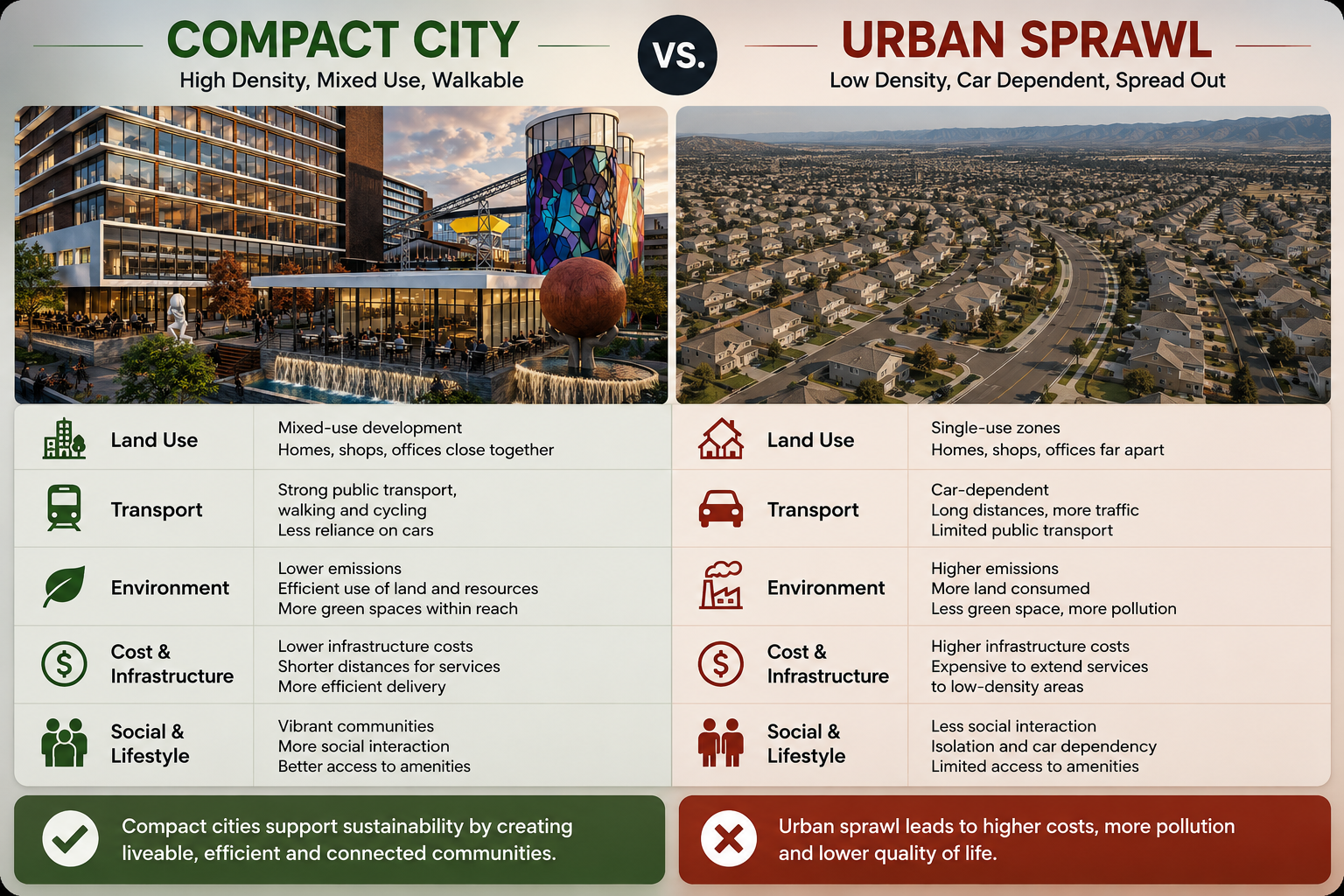
Image Source: https://www.reddit.com/r/cityplanning/comments/1t6h0yy/compact_city_vs_urban_sprawl/
More Efficient Infrastructure
Infrastructure is expensive.
Every new neighborhood requires roads, water systems, sewer lines, electricity, telecommunications, and stormwater management.
Compact mixed-use developments allow much of this infrastructure to be shared among multiple users.
Parking facilities, utilities, public spaces, and transportation networks serve residents, businesses, and visitors simultaneously, reducing duplication and improving long-term operational efficiency.
Supporting Public Transportation
Public transportation performs best when enough people live and work within walking distance of transit stations.
Mixed-use developments naturally create this density.
Instead of relying exclusively on private vehicles, residents can combine walking, cycling, buses, commuter rail, and other transit options for everyday travel.
This creates transportation systems that are more sustainable while reducing congestion across the broader metropolitan area.
Economic Benefits That Extend Beyond the Development
Mixed-use developments are often discussed in terms of sustainability, but they also provide significant economic advantages for developers, municipalities, businesses, and residents alike.
Rather than relying on a single land use, these projects create multiple sources of economic activity that reinforce one another.
Better Returns for Developers
For developers, diversification reduces risk.
Instead of depending entirely on residential sales or office leasing, mixed-use projects generate revenue from multiple property types, including retail, hospitality, office, residential, entertainment, and parking.
If one market temporarily slows, other components may continue generating stable income.
This diversified approach often improves long-term financial performance and increases project resilience during changing economic conditions.
Research published in the journal Real Estate Economics found that walkable office, retail, and apartment properties consistently command higher market values, with every 10-point increase in Walk Score associated with a 1% to 9% increase in property value, depending on the asset type.
For developers, this means thoughtfully designed mixed-use communities aren't simply more attractive places to live and work; they also represent stronger long-term investment opportunities supported by sustained market demand.
Stronger Local Businesses
Local businesses thrive when customers live and work nearby.
Restaurants benefit from office workers during lunch and residents in the evening. Coffee shops serve commuters in the morning and remote workers throughout the day. Grocery stores, pharmacies, gyms, and service providers enjoy a consistent customer base because people can easily walk to them.
This steady foot traffic supports small businesses while keeping spending within the local economy.
Increased Property Values
Walkable neighborhoods with convenient amenities are consistently among the most desirable places to live.
Properties located near restaurants, parks, retail, entertainment, and transit often command higher long-term values because buyers place a premium on convenience and quality of life.
When carefully planned, mixed-use developments can strengthen surrounding neighborhoods rather than competing with them.
More Efficient Public Investment
Municipal governments also benefit.
Compact development typically requires fewer miles of roads, utilities, and public services compared to low-density suburban expansion.
This allows cities to deliver infrastructure more efficiently while generating stronger property tax revenues from a smaller land area.
Over time, these efficiencies contribute to healthier municipal budgets and more sustainable urban growth.
Building Healthier, More Connected Communities
Cities are more than collections of buildings.
They're places where people build relationships, raise families, start businesses, and create lasting memories.
One of the greatest strengths of mixed-use development is its ability to foster these human connections.
Walkability Encourages Daily Interaction
Walking changes how people experience a neighborhood.
Instead of driving directly from one destination to another, pedestrians naturally encounter neighbors, local businesses, parks, and community events.
These small, everyday interactions create stronger social connections and contribute to a greater sense of belonging.
Over time, neighborhoods become more than places to live, they become communities.
Better Physical and Mental Health
Walkable communities also encourage healthier lifestyles.
When parks, trails, grocery stores, restaurants, schools, and workplaces are nearby, walking becomes part of daily life rather than a scheduled activity.
Residents often experience:
Increased physical activity
Reduced sedentary behavior
Better cardiovascular health
Improved mental well-being
Greater access to green space
Public plazas, community gardens, recreational facilities, and open spaces further encourage outdoor activity and social engagement.
Supporting Diverse Communities
Successful mixed-use developments attract a broad mix of residents, businesses, and visitors.
When thoughtfully planned, they can include:
Market-rate housing
Affordable housing
Local businesses
Restaurants
Community facilities
Public gathering spaces
This diversity creates opportunities for people from different backgrounds and income levels to interact in shared environments, strengthening social cohesion and promoting a more inclusive community.
Safer, More Vibrant Neighborhoods
Mixed-use communities remain active throughout the day.
Morning commuters, daytime office workers, afternoon shoppers, evening diners, and residents all contribute to a continuous presence of people.
This consistent activity helps create lively streets, supports local businesses, and increases the natural surveillance that contributes to safer public spaces.
Instead of neighborhoods that empty after business hours or commercial districts that become inactive at night, mixed-use developments create environments that remain vibrant from morning until evening.
Mixed-use developments demonstrate that good urban planning isn't simply about constructing more buildings, it's about creating places where environmental sustainability, economic opportunity, and community well-being reinforce one another. When homes, workplaces, businesses, parks, and public spaces are thoughtfully integrated, cities become more efficient, more resilient, and ultimately more enjoyable places to live.
Principles of Successful Mixed-Use Developments
Simply combining homes, offices, restaurants, and retail spaces within the same project doesn't automatically create a successful mixed-use development. In fact, many developments fail because they focus on mixing land uses without considering how those uses interact.
The most successful mixed-use communities are intentionally designed to create a seamless experience for residents, businesses, and visitors. Every element, from street layouts and public spaces to transportation and building placement, works together to support daily life.
Research on mixed-use planning consistently identifies several core principles that distinguish thriving developments from those that struggle.
1. Build Around People, Not Cars
For decades, many communities were designed with automobiles as the primary mode of transportation. Wide roads, expansive parking lots, and disconnected neighborhoods became common features of suburban development.
Mixed-use communities reverse that approach by putting people first.
Walkable streets, safe intersections, shaded sidewalks, bicycle paths, and inviting public spaces encourage residents to move through the community on foot rather than by car. This creates a more active streetscape where local businesses benefit from increased foot traffic and public spaces remain vibrant throughout the day.
Prioritizing pedestrians doesn't eliminate vehicles, it simply creates a healthier balance between different modes of transportation.
2. Achieve the Right Density
Density is often misunderstood.
Higher density doesn't necessarily mean overcrowding or high-rise skylines. Instead, it refers to using land efficiently so that enough people live and work within an area to support businesses, public transportation, and community amenities.
Without sufficient density:
Retail stores struggle to attract customers.
Restaurants experience inconsistent demand.
Public transit becomes less viable.
Community facilities remain underutilized.
Conversely, excessive density without adequate public spaces, infrastructure, or transportation can reduce quality of life.
Successful mixed-use developments strike a balance by creating compact neighborhoods that remain comfortable, accessible, and livable.
3. Create a Diverse Mix of Uses
A healthy community remains active throughout the day because it serves different needs at different times.
Morning commuters visit coffee shops. Office workers support restaurants during lunch. Residents enjoy parks and fitness facilities in the evening. Visitors attend entertainment venues at night.
This continuous cycle of activity is only possible when developments include a diverse mix of complementary uses.
A balanced mixed-use development may incorporate:
Residential housing
Office space
Restaurants and cafés
Retail stores
Hotels
Healthcare facilities
Schools and childcare
Community centers
Parks and recreational spaces
Housing diversity also plays an important role. Offering a range of housing types and price points helps create more inclusive communities that accommodate different family sizes, income levels, and stages of life.
4. Design for Walkability
Distance matters, but design matters even more.
People are far more likely to walk when routes are direct, attractive, comfortable, and safe.
Successful mixed-use developments prioritize features such as:
Wide sidewalks
Street trees and landscaping
Active storefronts
Outdoor seating
Safe pedestrian crossings
Human-scale architecture
Good lighting
Wayfinding signage
Buildings should engage the street rather than turn away from it. Blank walls, oversized parking lots, and inactive building frontages discourage walking and reduce the vitality of public spaces.
The goal is to create streets that people enjoy using rather than simply passing through.
5. Keep Everyday Destinations Close
Convenience is one of the defining characteristics of mixed-use development.
Residents should be able to reach essential destinations within a comfortable walking distance, including:
Grocery stores
Pharmacies
Schools
Parks
Restaurants
Fitness centers
Healthcare providers
Public transportation
Workplaces
Reducing travel distances not only improves convenience but also decreases dependence on private vehicles while encouraging healthier daily routines.
6. Connect to Public Transportation
Mixed-use developments perform best when integrated with broader transportation networks.
Reliable access to buses, commuter rail, light rail, and other transit options expands mobility while reducing congestion and parking demand.
Transit connectivity also makes communities more attractive to:
Young professionals
Students
Older adults
Remote workers
Visitors
Rather than replacing public transportation, mixed-use developments strengthen its effectiveness by concentrating housing, employment, and services around transit corridors.
Common Challenges of Mixed-Use Developments
While the benefits of mixed-use development are substantial, these projects are also among the most complex forms of urban development.
Creating a successful mixed-use community requires careful coordination between developers, architects, planners, engineers, local governments, investors, and community stakeholders.
Understanding the most common challenges can help ensure better long-term outcomes.
Higher Planning and Development Complexity
Mixed-use projects combine multiple property types within a single development, each with different design requirements, building codes, financing structures, and operational needs.
Coordinating residential, commercial, hospitality, office, and public spaces requires extensive planning and collaboration from the earliest stages of the project.
Although this complexity often increases upfront costs, it can deliver greater long-term value when executed successfully.
Balancing Residential and Commercial Demand
Finding the right mix of uses is one of the biggest challenges.
Too much retail without sufficient residents may result in vacant storefronts.
Too much housing without enough services can force residents to travel elsewhere for everyday needs.
Developers must carefully evaluate local market conditions, demographics, and long-term growth projections to create a balanced community that supports both businesses and residents.
Maintaining Housing Affordability
Successful mixed-use developments often become highly desirable places to live.
While increased demand can strengthen local economies and property values, it may also contribute to rising housing costs if affordability isn't considered during planning.
Many municipalities address this challenge by incorporating affordable housing policies, diverse housing options, and inclusionary zoning strategies that help preserve socioeconomic diversity.
Designing Effective Public Spaces
Public spaces are often described as the "living room" of a mixed-use community.
However, simply including parks or plazas isn't enough.
Successful public spaces must be:
Easy to access
Comfortable throughout the year
Safe and well-maintained
Flexible enough to accommodate events and everyday activities
Integrated with surrounding businesses and pedestrian routes
Poorly designed public spaces often remain underused regardless of their size.
Managing Transportation and Parking
Although mixed-use developments reduce car dependency, parking and transportation remain important planning considerations.
Residents, employees, customers, delivery vehicles, emergency services, and visitors all have different transportation needs.
Modern developments increasingly address this challenge through:
Shared parking facilities
Structured parking
Bicycle storage
Electric vehicle charging
Ride-share pickup zones
Enhanced pedestrian infrastructure
Transit-oriented planning
The objective is to accommodate multiple transportation options while avoiding excessive land devoted to surface parking.
Real-World Examples of Successful Mixed-Use Developments
Around the world, mixed-use developments are demonstrating how thoughtful planning can create thriving communities that support economic growth, sustainability, and quality of life.
Fields West – Frisco, Texas
Fields West is part of a larger master-planned development that integrates residential neighborhoods with office space, hotels, restaurants, retail, and entertainment destinations.
Designed as a walkable community, it allows residents, employees, and visitors to live, work, shop, dine, and socialize within the same district while reducing the need for long daily commutes.
It illustrates how large-scale mixed-use planning can support both economic development and long-term community growth.
Hudson Yards – New York City
Hudson Yards transformed a former rail yard into one of the largest private real estate developments in the United States.
The district combines:
Office towers
Luxury residences
Retail
Restaurants
Hotels
Public plazas
Cultural attractions
Its integration with public transportation and public spaces demonstrates how high-density mixed-use development can revitalize underutilized urban land.
The Wharf – Washington, D.C.
The Wharf revitalized the city's waterfront by blending residential buildings, offices, hotels, restaurants, retail, entertainment venues, parks, and marinas into a vibrant mixed-use destination.
The project has become a year-round gathering place for both residents and visitors while stimulating economic activity throughout the surrounding area.
Santana Row – San Jose, California
Santana Row demonstrates how mixed-use development can create an active urban neighborhood through carefully designed streets, outdoor dining, shopping, offices, residential units, and public events. Its pedestrian-friendly design encourages people to spend time outdoors while supporting local businesses throughout the day and evening.
El Cajon Mixed-Use – California
Not every successful mixed-use development spans hundreds of acres. Urban infill projects also play an important role in creating walkable, economically vibrant neighborhoods.
Our El Cajon Mixed-Use project demonstrates how thoughtfully integrating residential living with commercial space can activate existing urban corridors while supporting long-term community growth. By maximizing land efficiency and encouraging pedestrian activity, projects like this show how mixed-use principles can be successfully applied at a neighborhood scale.
Great Mixed-Use Developments Don't Happen by Accident
The most successful mixed-use communities share one important characteristic: every decision is intentional.
Density supports local businesses. Walkable streets encourage social interaction. Public spaces become gathering places. Transportation connects neighborhoods to the broader city. Housing, employment, recreation, and commerce reinforce one another rather than competing for space.
When these elements are thoughtfully integrated, mixed-use developments become far more than real estate projects, they become complete communities designed to adapt, grow, and thrive for generations.
The Future of Mixed-Use Developments
Cities are constantly evolving. As populations grow, lifestyles change, and environmental concerns become more urgent, the way we plan and build our communities must evolve as well.
For decades, urban expansion largely followed a predictable pattern, new neighborhoods spread farther from city centers, connected primarily by roads and highways. While this model accommodated rapid growth, it also increased traffic congestion, consumed valuable farmland, strained public infrastructure, and made communities increasingly dependent on private vehicles.
Today, cities are moving in a different direction.
Instead of asking "How can we build more?", planners and developers are asking "How can we build better?"
Mixed-use developments represent one of the clearest answers to that question.
By integrating housing, workplaces, retail, public spaces, and essential services into walkable neighborhoods, these developments address many of the challenges facing modern cities simultaneously. Rather than treating housing, transportation, economic development, and sustainability as separate issues, mixed-use communities bring them together into one coordinated solution.
As cities continue to invest in public transportation, smart infrastructure, renewable energy, and resilient urban planning, mixed-use developments will likely play an even greater role in shaping healthier and more connected communities.
Supporting Smarter Urban Growth
The future of urban development isn't necessarily about building taller buildings or expanding city boundaries. It's about making better use of the land we already have.
Mixed-use developments support this vision by creating compact, efficient neighborhoods where infrastructure, public services, and amenities are shared rather than duplicated.
This approach helps cities accommodate population growth while minimizing the environmental and financial costs associated with urban sprawl.
Meeting the Needs of Changing Demographics
Communities must also evolve alongside the people who live in them.
Young professionals increasingly seek neighborhoods that offer convenience, walkability, flexible workspaces, and vibrant public life. Families value access to schools, parks, healthcare, and recreational facilities. Older adults often prioritize accessible housing, nearby medical services, and the ability to remain active without relying on a car.
Well-planned mixed-use developments can serve all of these groups by providing diverse housing options and a wide range of community amenities within close proximity.
Their flexibility makes them better equipped to adapt as demographic trends continue to evolve.
Building More Resilient Communities
Recent global events have highlighted the importance of resilient cities.
The COVID-19 pandemic changed how people work, shop, and interact with their communities. Climate change continues to challenge infrastructure, transportation systems, and public health. Economic uncertainty has reinforced the need for diversified local economies.
Mixed-use developments are naturally more resilient because they combine multiple uses within the same environment.
When one sector experiences slower growth, others often continue to support activity within the community. This diversity helps create neighborhoods that remain active, economically productive, and socially connected over time.
Technology Will Continue to Shape Mixed-Use Communities
Emerging technologies will further strengthen mixed-use developments in the coming years.
Smart infrastructure, intelligent traffic management, renewable energy systems, electric vehicle charging networks, and digital connectivity are already transforming how communities function.
As these technologies become more widely adopted, mixed-use developments will be well positioned to integrate them because of their compact design and coordinated planning.
Technology alone doesn't create successful communities, but when combined with thoughtful urban design, it can improve efficiency, accessibility, sustainability, and quality of life.
Frequently Asked Questions About Mixed-Use Developments
1. What is a mixed-use development?
A mixed-use development is a building, neighborhood, or master-planned community that intentionally combines multiple land uses, such as residential, commercial, office, hospitality, recreation, and public spaces, within a single, integrated environment. The goal is to create walkable communities where people can live, work, shop, and socialize with minimal reliance on private vehicles.
2. What is the difference between mixed-use and multi-use development?
Although the terms are sometimes used interchangeably, they are not the same.
A multi-use development simply places different land uses near one another.
A true mixed-use development intentionally integrates those uses through thoughtful planning, pedestrian-friendly design, connected public spaces, and complementary activities that support one another throughout the day.
3. What are the different types of mixed-use developments?
Mixed-use developments generally fall into three categories:
Vertical mixed-use, where multiple uses occupy different floors of the same building.
Horizontal mixed-use, where different buildings within one development serve different purposes.
District-scale or master-planned mixed-use communities, which integrate residential, commercial, recreational, civic, and public spaces across an entire neighborhood.
4. What are the biggest benefits of mixed-use developments?
Some of the most significant advantages include:
Reduced traffic congestion and car dependency
Lower greenhouse gas emissions
More efficient land use
Stronger local economies
Higher walkability
Better public health and well-being
Greater community interaction
Improved support for public transportation
Diversified investment opportunities
Increased resilience to changing market conditions
5. Are mixed-use developments sustainable?
Yes - when designed thoughtfully.
Mixed-use developments promote sustainability by encouraging walking, cycling, and public transportation while reducing vehicle emissions and making more efficient use of land and infrastructure.
Many modern developments also incorporate green building practices, renewable energy systems, water conservation measures, and expanded public green spaces.
6. What challenges do mixed-use developments face?
Despite their advantages, mixed-use projects require careful planning and coordination.
Common challenges include:
Balancing residential and commercial uses
Maintaining housing affordability
Managing parking and transportation
Designing successful public spaces
Meeting zoning and regulatory requirements
Coordinating multiple stakeholders throughout the planning and construction process
Addressing these challenges early significantly improves long-term project success.
7. Why are mixed-use developments becoming more popular?
Several factors are driving their growth, including:
Urban population growth
Housing shortages
Sustainability goals
Rising infrastructure costs
Changing work patterns
Demand for walkable neighborhoods
Increased investment in public transportation
Growing interest in healthier, community-focused lifestyles
Together, these trends are reshaping how cities approach future development.
See Our Mixed-Use Projects in Action
While every community has unique goals and constraints, the principles discussed throughout this guide are reflected in many of our own architectural projects.
Explore a few of our mixed-use developments:
City Center Master Plan — A master-planned mixed-use community designed to strengthen economic activity and public life.
El Cajon Mixed-Use — An urban mixed-use development that integrates residential and commercial uses within an existing neighborhood.
Cleaver Lofts — A vertical mixed-use project that maximizes land efficiency while creating an active, pedestrian-friendly environment.
Ready to discuss your mixed-use project?
Schedule a FREE consultation with our Principal Architect and let's explore how thoughtful architecture can create lasting value for your community.
Final Thoughts
Mixed-use developments are not a passing trend or simply another approach to real estate development. They represent a fundamental shift in how we think about cities and the people who live in them.
For much of the last century, urban growth was defined by separation. Homes in one place, offices in another, shopping centers somewhere else, all connected by increasingly congested roads. While that model supported rapid expansion, it also created many of the challenges cities face today, including urban sprawl, traffic congestion, environmental degradation, housing shortages, and fragmented communities.
Mixed-use developments offer a more balanced alternative.
By integrating residential, commercial, recreational, and public spaces into connected, walkable neighborhoods, they create environments where people can spend less time commuting and more time living. They strengthen local economies, support healthier lifestyles, encourage social interaction, and make more efficient use of land and infrastructure.
Of course, successful mixed-use development requires more than simply combining different building types. It depends on thoughtful planning, human-centered design, appropriate density, strong transportation connections, vibrant public spaces, and a deep understanding of the needs of the communities they serve.
When these principles come together, the result is more than a development; it is a place where people want to live, work, gather, and build lasting connections.
As cities continue to evolve, mixed-use developments are poised to become one of the defining models of sustainable urban growth. For architects, developers, planners, and civic leaders, the opportunity is no longer just to construct buildings, it is to create resilient, inclusive, and thriving communities that improve people's lives for generations to come.
About the Author
Robert Sidney Aulds III is a licensed Architect, builder, developer, and author. With a career spanning from single-family residences to high-rise developments, he founded Sidney Aulds Building Studio to focus on custom residential and urban mixed-use development. Sidney is also the founder of Pursuing Excellence, a personal development system focused on productivity, discipline, and planning. Driven by a passion for creating and leadership, Sidney aims to help individuals reach their best selves through his work in real estate and personal development.